
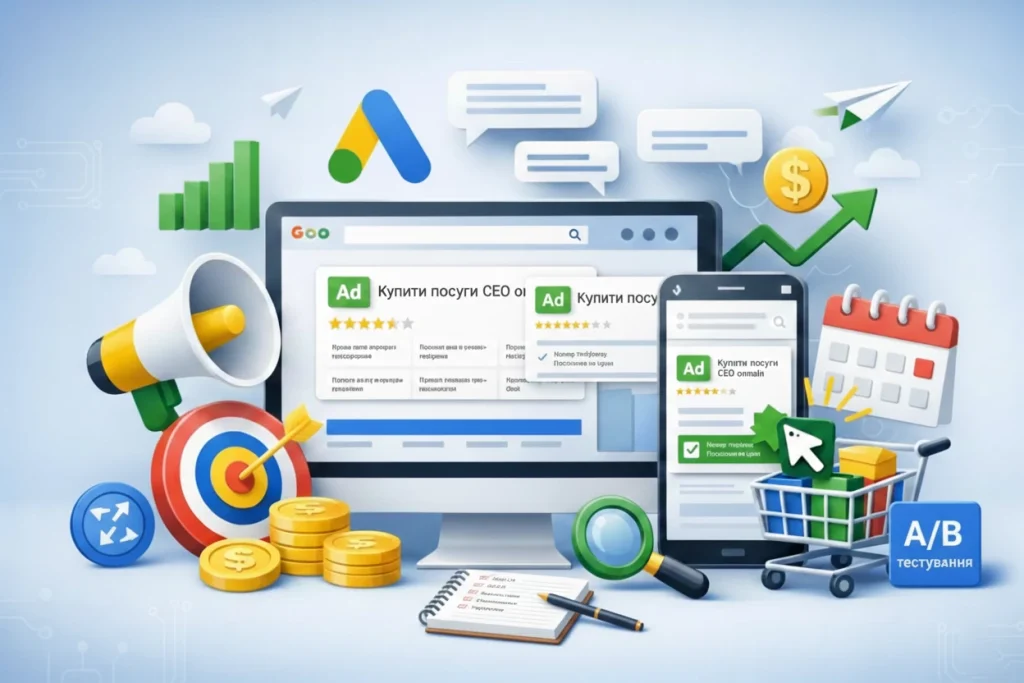
Have you ever noticed that as soon as you search for “buy sneakers” or “washing machine repair,” the first three or four results carry a subtle “Ad” label? This is contextual advertising. For a business, it is the fastest way to find a customer who is already prepared to pay. While results from organic search engine optimization (SEO) can take months to appear, advertising brings in people just an hour after setup.
However, be cautious: without understanding the operating principles, this tool can become a “black hole” for your budget. Let’s look at how to do it right.
Step 1. Defining the Goal: Not Just Clicks, but Sales
The first mistake many make is launching ads just to “get clicks.” Analytics show that over 40% of advertising budgets are wasted on people who never intended to buy. Your goal must be specific: a phone call, a registration, or a checkout purchase. Only then will the system understand exactly which people to bring to you.
Step 2. Keyword Selection: Think Like Your Customer
Contextual advertising works based on keywords. Interesting fact: search queries consisting of 3-5 words have an 18% higher conversion rate than short, general phrases.
- Good: “Buy wooden kitchen table.” (This is a target buyer). Don’t forget about “negative keywords.” If you only sell new items, add “used” to your exclusion list so you don’t pay for clicks from people looking for cheap second-hand options.
- Bad: “Furniture.” (You will get a lot of random visitors).

Step 3. Ad Creation: Clarity Over Poetry
You have only a few seconds to catch the eye. A good ad consists of three parts:
- Headline: Provides an immediate answer to the search query.
- Benefit: Why you? (Free shipping, 5-year warranty, technician arrives within an hour).
- Call to Action (CTA): What should the person do? (“Call now,” “Browse the catalog,” “Get a discount”).
Step 4. Landing Page: Where Does the Customer Land?
This is the most critical stage. You can set up the perfect ad, but if a person clicks “buy red dress” and lands on a homepage with a bit of everything, they will leave. The page must be a logical continuation of the ad. Loading speed is critical here: every second of delay reduces orders by 7-10%.
Step 5. Budget and Geography Settings
Don’t try to cover the whole country if you only operate in one city. Google Ads allows you to show ads even within a 5-kilometer radius of your store. Start with small amounts, test different ad variations, and keep only those that bring in real calls and orders.

Why Does This Work Better Than Other Advertising?
Unlike television or billboards, contextual advertising is not intrusive. It appears exactly when a person is actively looking for a solution to their problem. It is a dialogue initiated by the customer, where you simply offer your help at the right time. Furthermore, you don’t pay for impressions—you only pay for actual visits to your website.
Google Ads is a powerful engine for business, but it requires precise tuning. Don’t be afraid to experiment, but always look at the data rather than your own intuition. If you see that a certain keyword brings many clicks but zero purchases—turn it off without hesitation. Money in advertising should work, not just be spent.


Comments